Cart
0
You may also like


Spring competition season is here, and gear check is the last hurdle between you and your score. Under the Equestrian Australia (EA) National Dressage Rules, a gear check is compulsory after every test, and the stakes are real. Wrong gear, such as a bit, noseband or saddle the rules don't permit, usually means elimination. The 0.5% penalty from each judge under rule 5.1 is for incorrect dress only.
Our post on what to wear to a dressage competition covers the rider. This one covers your horse, based on the EA National Dressage Rules effective 1 January 2026 and the EA Dressage Equipment Annex (version 23). It applies to EA events. FEI events, Pony Club and riding clubs have their own rules, so check the schedule before you pack.
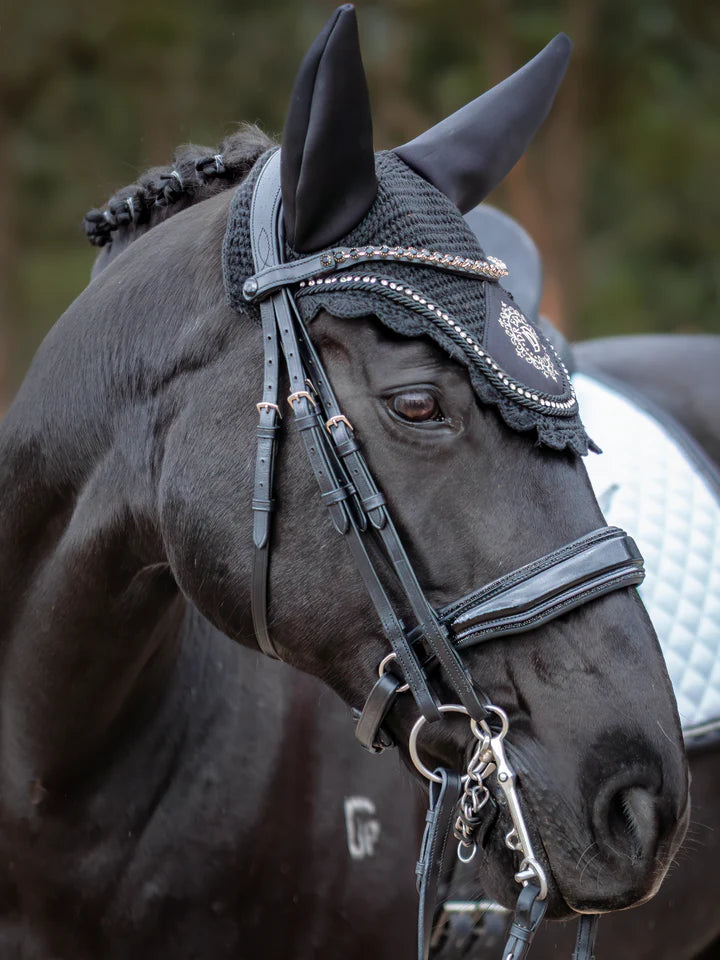
Ear bonnets (the rulebook calls them ear hoods) are permitted in the arena under rule 5.14, as long as:
Ear plugs are a different story. They're only permitted during presentations. Fly masks mean elimination (Equipment Annex, section 6), so keep those for the paddock.
A sound-proof ear bonnet can help a horse that's bothered by the loudspeaker, flapping marquees or a busy warm-up. Fit matters twice here: a bonnet that slips over the eyes can fail gear check, and one that's too tight will annoy your horse for the whole test.
This one catches people out. Rule 1.5 points to EA General Regulations Article 141, which says the hair inside the ear can't be removed or shortened within the rim of the ear. Since 1 July 2025, horses competing with trimmed ear hair are eliminated. The same article protects sensory hairs, so the whiskers around the muzzle and eyes can't be clipped either.
Rule 5.11 keeps the bridle itself classic: black or brown, made of leather or leather-like material, with coloured accents or piping allowed. If you like a little contrast, a black bridle with white piping is within the rules. Any padding has to be discreet and sit on the underside of the bridle. Fleece or padding showing on top of the bridle can mean elimination (Equipment Annex, section 3).
The browband is where you have room to play. It's compulsory, and apart from the ends that attach to the headpiece, it doesn't have to be leather (rule 5.11d). Nothing in the EA dressage rules specifically restricts crystals on the browband, which is why a crystal browband is the classic way to add sparkle to your horse's turnout.
The rest of the horse stays plain. Crystal mane bands and any decoration in the mane or tail, such as ribbons, flowers or glitter, mean elimination. The only exception is a red ribbon in the tail to warn other riders that a horse kicks (rule 5.12).
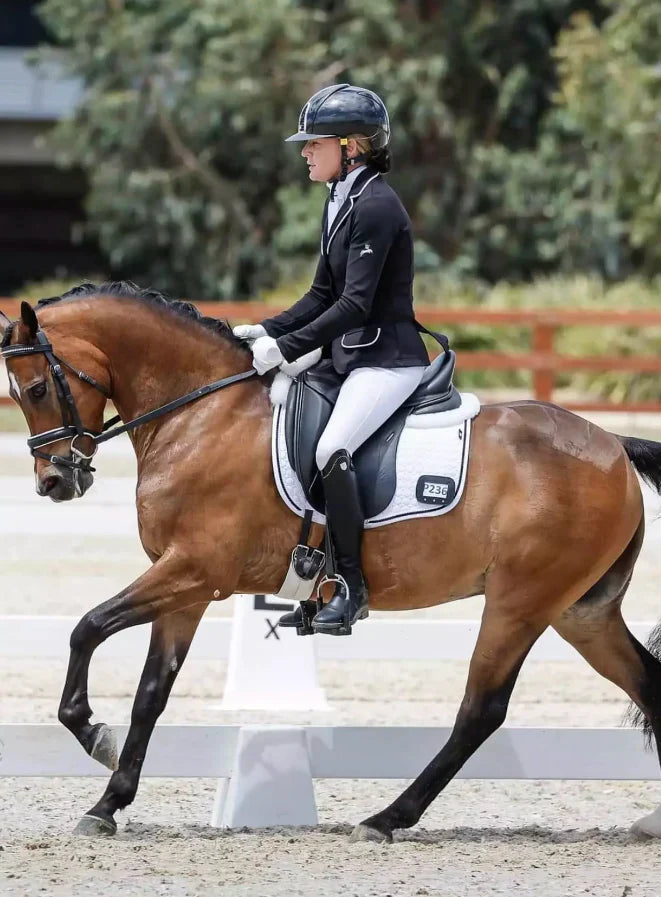
Rule 5.10 says white is preferred for saddlecloths, pale colours are permitted and coloured piping is fine. A sheepskin or fleece girth cover is allowed too. The saddle must be black or brown, although coloured piping around the edges is permitted. Saddle covers, such as sheepskin seat savers and rain covers, are for warm-up only and must come off before you ride to the arena (rule 5.12).
Our white cotton drill competition pad has navy or black trim, clear crystals and interchangeable numbers built in.
Rule 4.8.5 sets out how horse identification numbers must be worn:
Riding into the arena without correct numbers costs 0.5% from each judge. Around the grounds, you'll get a verbal warning first, then a yellow warning card. Stallions also need green stallion discs or green number holders on both sides.
If your saddle pad has built-in numbers, check that the digits are dark on a white background and easy to read from the judge's box.
Boots, bell boots and bandages are fine in warm-up but not in the competition arena (rule 5.17). Wearing them in the space around the arena costs 0.5% from each judge, and so does wearing them in the arena. Removable hoof boots can't go past gear check either (rule 5.16).
Take your brushing boots off at the end of warm-up, before you ride to the arena, so nothing gets forgotten in the rush.
EA reviews its dressage rules regularly. Everything above comes from the EA National Dressage Rules effective 1 January 2026 and the Dressage Equipment Annex version 23, both on the EA dressage rules page. If you're unsure about a piece of gear, ask the gear steward or technical delegate before your test, not after it.
Questions about sizing or fit before a competition? Email us at info@thedressagediva.com.au and we'll help you get it right.